

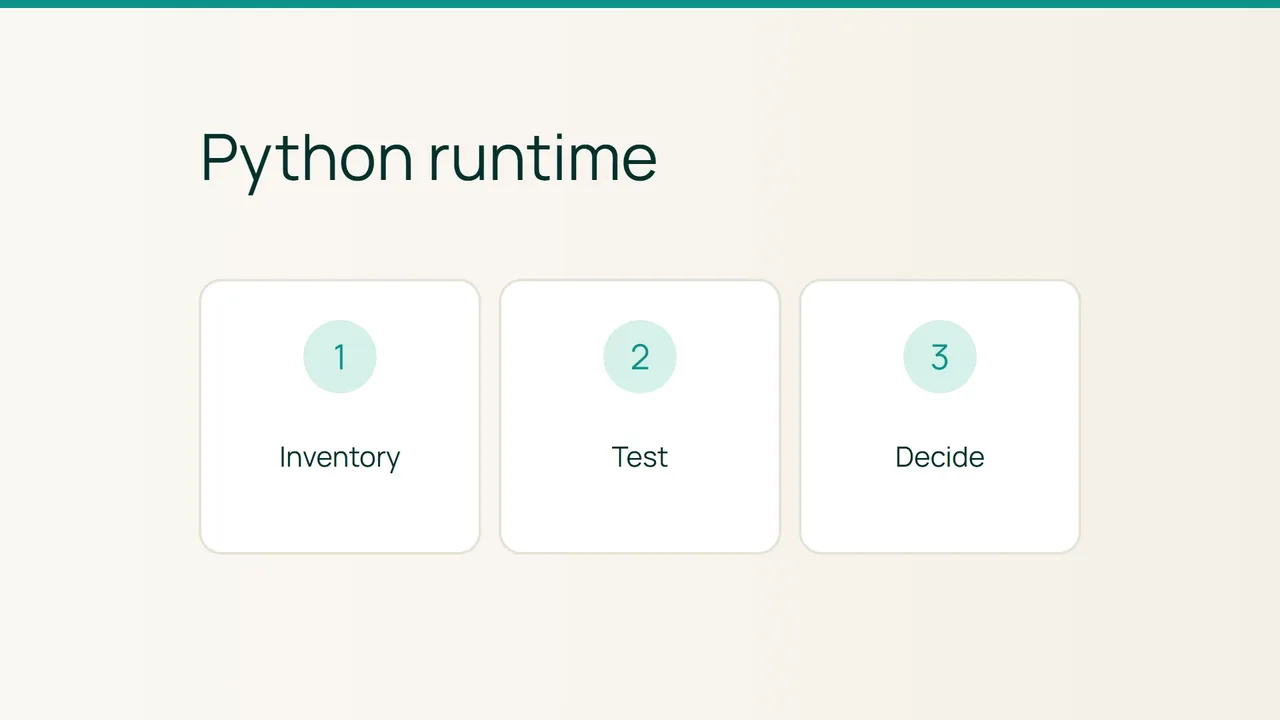
Python Workers reaching general availability creates another possible home for a Python website. Cloudflare's announcement includes Flask, Django and FastAPI support, but a supported framework is only part of a working application. Before moving traffic, build a small compatibility record for the application you actually operate.
1. List the runtime assumptions
Start with the deployed release, rather than a developer's laptop. Record its Python version, locked dependencies, framework and startup command. Add the resources it relies on: a database, uploaded files, scheduled work, outgoing email and external APIs.
For each resource, write down how the application connects, where credentials are supplied and what harmless operation will demonstrate success. This becomes your test plan. Keep credentials out of the document; refer to their managed locations instead.
Cloudflare explains that its Python environment uses Pyodide and WebAssembly. Packages containing native extensions need compatible builds. Do not treat a package that installs on a Linux VPS as automatically portable. Give every native dependency an explicit status: verified, replacement needed or unresolved. An unresolved dependency is a reason to investigate before migration.
2. Exercise a representative application slice
Create an isolated deployment with synthetic records and test credentials. Follow the target runtime's entry-point model. Workers provides WSGI and ASGI connectors; copying the command used to start your existing web server is not a complete deployment procedure.
Run a short sequence that crosses the important boundaries:
- Request a page and inspect its actual content.
- Read and write a disposable record in a test database.
- Upload a harmless file and check its availability after redeployment.
- Trigger a background task and locate its completion record.
Also check a controlled failure, such as a missing test resource. The response should explain the failure without disclosing configuration or secrets. Record the release, time, expected outcome and observed result so someone else can repeat the exercise.
A successful import only proves that the import worked. It does not prove that a database connection, persistent upload or deferred job behaves correctly on the destination.
3. Make the migration decision explicit
Review the evidence against the customer journey that matters to your business. A fast home page cannot compensate for a failed order or a file that disappears after deployment. Give each incompatibility a concrete remedy and an owner.
If the application passes, prepare the traffic change and the return procedure together. Explain how new writes will be preserved if you return to the previous deployment. If a required capability remains unresolved, keep the current service running while you investigate it.
The useful outcome is a reproducible compatibility decision, not simply a successful platform demo. This checklist is an application-level exercise inspired by the announcement, rather than a claim that every existing Python project will migrate unchanged.
Sources: Cloudflare.