

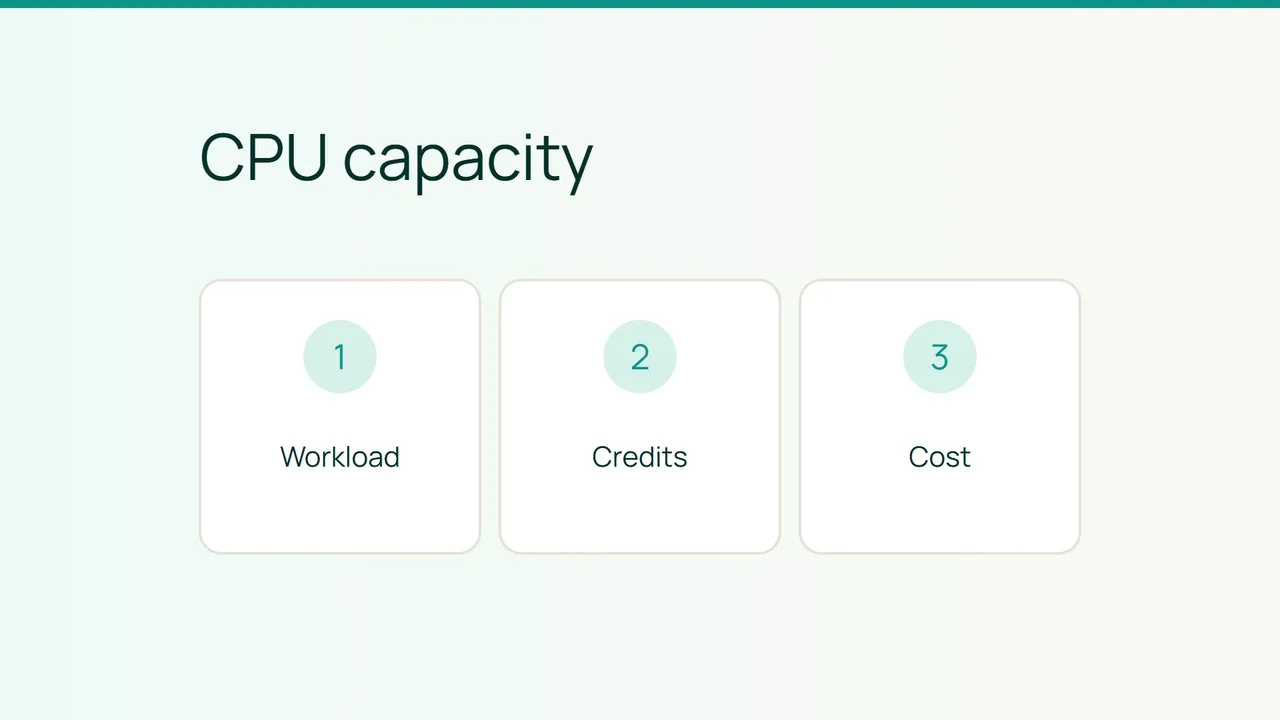
Amazon's EC2 T8i announcement is a useful reminder that burstable CPU is a performance model, not just a smaller instance size. The model combines baseline performance with CPU credits for bursts. Before choosing it for a website, compare the length of your busy periods with the rules of the configuration you intend to use.
1. Describe the workload over time
Select an observation period that includes ordinary visits, backups, imports and scheduled jobs. If a promotion will change demand, add a representative scenario in an authorized test environment. A quiet afternoon is not evidence that a sales campaign will fit the same resources.
Record CPU use alongside request volume, response time and errors. Keep the sampling interval with the observations. Long averages can hide periods that hurt visitors, while a single peak tells you little about how long the pressure lasted.
AWS positions T8i for low-to-moderate CPU workloads and explains that it uses CPU credits. That description does not establish whether your application fits. Include memory and storage observations in the review as well: a slow page is not automatically a CPU problem.
2. Compare the actual operating modes
For each candidate configuration, record baseline performance, credit behavior and the selected mode. The announcement lists Standard and Unlimited for T8i and states that Unlimited is the default. Check the effective setting instead of assuming the advertised instance rate describes every workload outcome.
Prepare a comparison of two configurations that can run your application. Capture four items for each:
- What happens during sustained CPU demand.
- Which credit measurements are available to monitor.
- Which current pricing conditions apply to the chosen mode.
- Whether memory and storage requirements are also met.
Use the provider's current pricing when making the purchase decision, and date your internal calculation. Treat headline performance claims as provider comparisons, not guaranteed savings for your own site. Do not compare configurations using the vCPU count alone.
3. Run a bounded trial
Replay the same customer journey on a test copy, long enough to observe the direction of the credit balance and the response behavior. Decide the acceptable application performance and trial spending limit beforehand. Keep the tested data and traffic pattern comparable between candidates.
If credits steadily decline or the cost becomes difficult to predict, evaluate a configuration suited to sustained work. If the workload remains within the expected behavior and meets your requirements, preserve the measurements as the basis for your choice.
Your decision needs three pieces of evidence: a working customer journey, understood behavior under load and a cost model you can explain. A successful short benchmark supplies only part of that evidence.
Sources: AWS News Blog.