

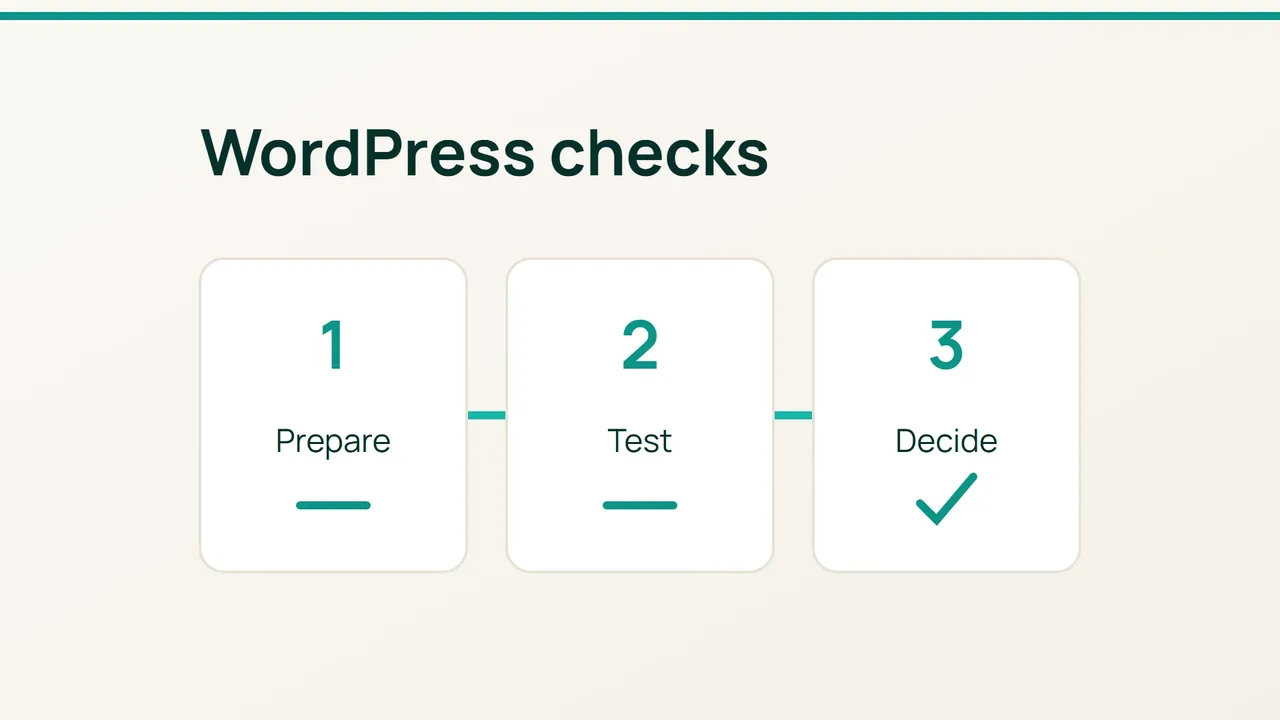
Before your next WordPress update, decide what evidence would convince you that the site still serves its customers. Kinsta's September 10, 2026 article discusses human oversight in automated WordPress work. The worksheet below is our practical way to turn that question into a repeatable acceptance check.
1. Choose outcomes you can observe
Start with the site address, the planned change and the person responsible for the final decision. Then describe a few customer journeys in everyday language. Avoid a broad item such as “check the website.” Give the tester a destination and a result they can actually observe.
For an event site, a useful sequence might be finding an event, submitting a test registration and receiving its acknowledgement. For a business directory, it could be searching for a listing, opening its details and sending an enquiry. Choose journeys that reflect what your own visitors need.
Run those checks before the update and record the results. This gives the person reviewing the change a baseline, including any existing problems. Use test contact details you control, and identify the entries clearly so colleagues can recognise them.
2. Make the worksheet reproducible
Use this starting layout, replacing every example with a real page or action from your site:
| Check | Expected outcome | Evidence |
|---|---|---|
| Open a listing | Required details are readable | Page address and screenshot |
| Send a test enquiry | Confirmation is displayed | Time and confirmation text |
| Check the test inbox | Enquiry has arrived | Subject and receipt time |
Add separate before and after columns. We suggest three possible results: passed, issue found and not tested. Leave a missing check visible instead of treating silence as a pass.
Write down the browser and the exact steps used where they affect reproduction. Someone else should be able to follow the worksheet without asking which button you meant. Keep private customer information out of screenshots and test messages.
If the work uses a staging copy, put that environment's address at the top. Ask the technical owner to confirm how email and external integrations are isolated before testing. A copied site should not be assumed to have every outside service disconnected.
3. Agree on a stopping rule
Our suggested acceptance rule is that a new failure in the main customer journey, or an unfinished check, requires a decision before the update can be called successful. Name the reviewer and the contact route while everyone is still available.
Prepare a handoff with five fields: change, environment, expected result, observed result and evidence. This gives the reviewer a reproducible problem instead of a vague failure notice.
Before the work starts, have the technical owner confirm the usable backup and the planned recovery procedure. When the checks finish, keep the dated worksheet and decision together. For the next update, revise the checklist using anything that this round failed to cover.
Sources: Kinsta.