

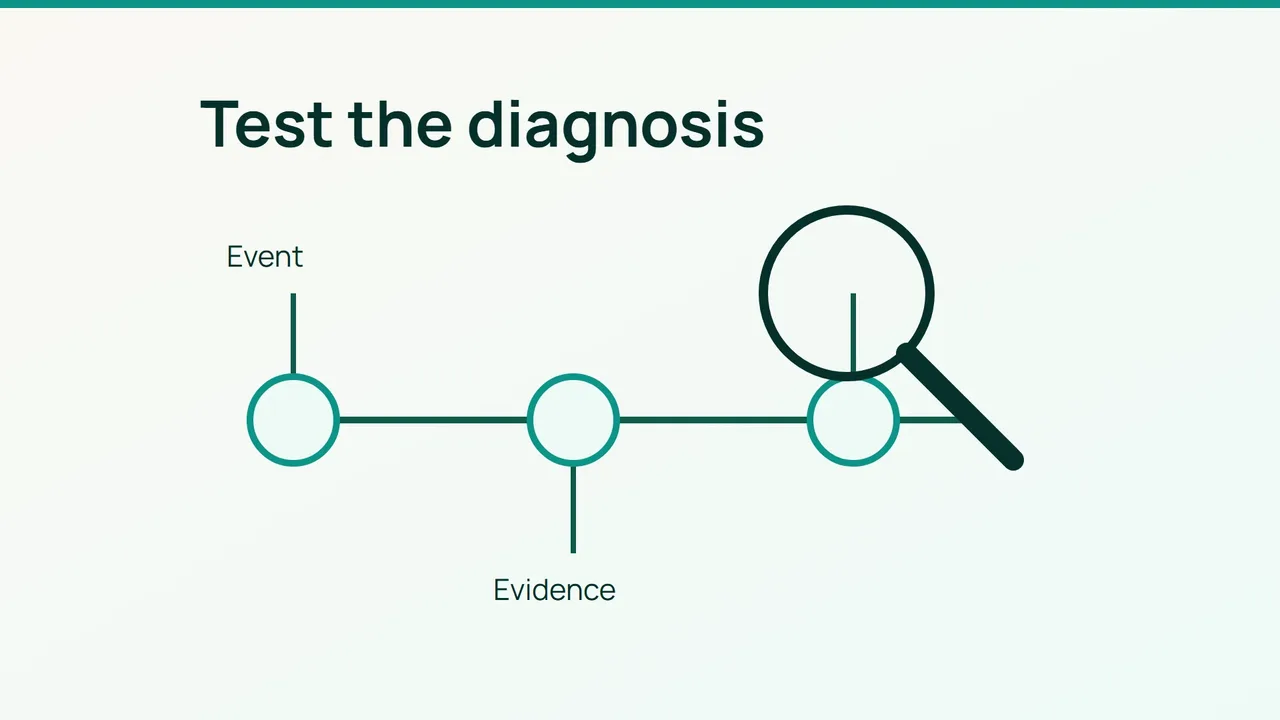
A convincing explanation of an outage is still a hypothesis. Hostinger’s account of AI-assisted work describes fixes that can look reasonable in isolation; this guide turns an assistant’s diagnosis into checks you can assess before changing your website.
1. Build a factual timeline
Start an incident note with the affected journey, observed error, first known failure and last relevant change. Attach a source to each observation and include time zones. If an event time is approximate, preserve that uncertainty rather than letting the assistant assign it a precise timestamp.
Ask for three separate lists: observed facts, proposed causes and missing evidence. An HTTP 502 response belongs in the first list if you recorded it. Connection exhaustion belongs in the second unless measurements support it. Remove references to log entries that were never supplied.
Include counterexamples. A successful page may use some of the same infrastructure as the failing page. That comparison helps narrow the investigation, although one success does not establish that an entire service is healthy. Keep the request paths and test conditions clear.
2. Specify a falsifiable check
For each proposed cause, write down what evidence would support it and what would count against it. Prefer a read-only observation: service state, component errors, an existing metric or a controlled request in a test environment. Avoid turning the assistant’s first suggestion directly into a production command.
A useful worksheet might contain these fictional entries:
Hypothesis: external service waitExpected: delay on the same requestCheck: compare two redacted tracesAgainst: call completed before the errorOutcome: support, reject or investigateCorrelate events from the same request where possible. Two problems occurring near each other are not automatically connected. Compare the proposed cause with the timeline too: a configuration change cannot explain a failure that clearly began before it.
Test one hypothesis at a time. Restarting several components while changing settings may remove the symptom, but it leaves little evidence about the original cause. It also makes the next result difficult to compare with the first observation.
3. Record the decision separately
Save the raw result and your interpretation in separate fields. An unavailable metric means unverified, not healthy. Give the assistant the new evidence and ask it to revise its explanation without filling gaps with assumptions.
Before implementing a fix, identify the specific component, expected effect, reversal method and user journey to retest. Follow your normal change review process. The aim is a justified action with an observable outcome, rather than a succession of plausible interventions.
Close the note with either a supported cause or an explicit statement that the cause remains uncertain. Attach the evidence needed by the next person investigating a recurrence. Restoring the service and understanding the incident are distinct outcomes; record both accurately instead of treating a disappearing error as proof that the initial AI diagnosis was correct.
Sources: Hostinger